Where the Canyon Learned My Name
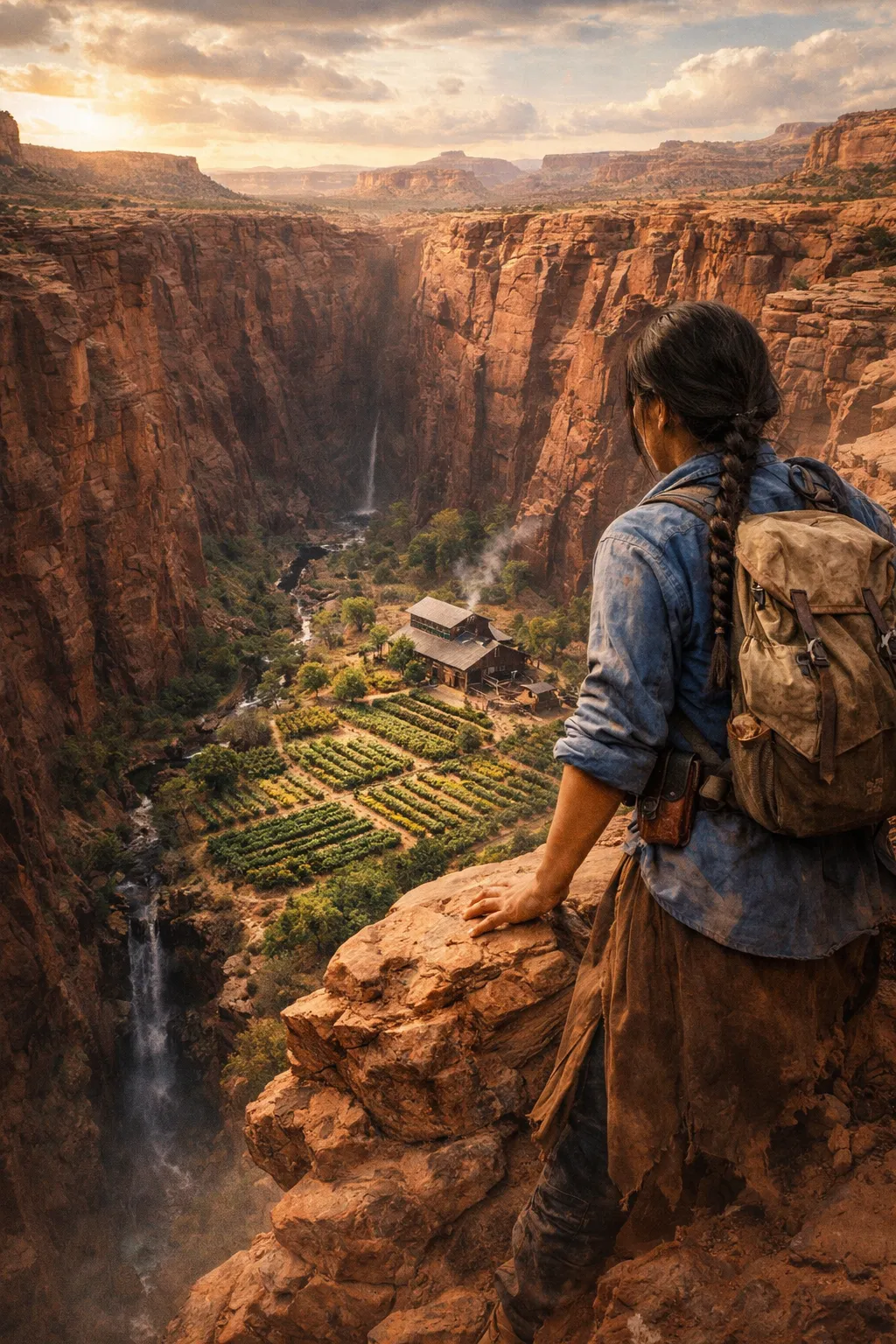
The first time I brought something living down into the canyon, it died before sunset.
It was a small thing. A handful of seeds wrapped in cloth, taken from a kitchen garden behind St. Catherine’s. I had stolen them the night before I left—beans, I thought. Or maybe squash. I hadn’t cared which. I only knew they were alive once, and I wanted to see if life could exist here again.
By noon, I had scratched a shallow line into the canyon floor, poured a little of the hidden water over the dust, and pressed the seeds into the damp soil like a promise.
By evening, the dampness was gone.
The soil had hardened back into something closer to stone than earth. When I dug with my fingers, I found the seeds cracked, split open, already surrendering.
I sat there in the blue shadow, dirt under my nails, and understood something simple and brutal:
Water was not enough.
The canyon did not want to be changed.
That night was colder than I expected.
The desert above held heat, but the canyon swallowed it. By the time darkness settled, the air turned sharp enough to bite. I wrapped myself in my coat and lay against the rock wall, listening.
At first, there was nothing.
Then, slowly—
A sound.
Soft.
Irregular.
A drip.
I sat up.
It came again.
Drip.
Not from above. Not from the sky. From somewhere deeper in the stone.
I followed it in the dark, hands sliding along the wall until my fingers found a narrow crack. Cool air moved through it, carrying that same scent I had noticed before—wet stone, hidden water.
I pressed my ear to the rock.
Drip.
Drip.
Drip.
Not constant.
Not reliable.
But there.
Alive.
The canyon was not empty.
It was breathing.
The next morning, I went back to the chamber.
The hidden pool waited where I had left it, still and silent. But I did not rush to it this time. I stood at the edge and watched.
The surface was too calm.
Too perfect.
Like something that only pretended to be water.
I knelt slowly and dipped my hand in again.
The same shock ran up my arm.
Cold.
But deeper than cold.
I held my hand there longer this time, forcing myself not to pull away.
The sensation changed.
At first, it had been sharp, like touching ice.
Now—
It softened.
Spread.
Moved.
Not just across my skin, but through it.
I closed my eyes.
And for a moment—
I was not in the chamber.
I was above it.
On the rim.
Watching rain fall into the canyon.
Not the light, brief rain of the desert.
A storm.
Heavy.
Relentless.
Water rushing over the edges, pouring down the walls, filling the cracks, sinking into the stone.
The canyon alive with sound.
With movement.
With force.
Then—
Silence.
The vision snapped away.
I jerked my hand out of the pool, gasping.
The chamber was still.
The water was still.
Nothing had changed.
Except me.
I did not plant again that day.
Or the next.
Instead, I watched.
I followed the sound of dripping water through the canyon, mapping it in my mind the way I had once mapped the stars. Small cracks. Hidden seams. Places where the stone darkened slightly, just enough to betray moisture beneath the surface.
There was water here.
Not in one place.
Not freely.
But moving.
Slow.
Patient.
Like something that had learned to survive by hiding.
I began to understand why my grandfather had walked this canyon for 30 years.
He had not been searching for water.
He had been learning it.
On the fourth day, I tried again.
This time, I did not plant in the open.
I found a narrow bend in the canyon where the wall curved inward, creating a shallow pocket that caught what little light filtered down. The stone there felt different—cooler, softer beneath the surface.
I dug deeper.
Not just scratching the top, but breaking through the hard crust until I reached something darker beneath. The soil there was finer, almost like dust that had once been mud.
I carried water from the hidden chamber in my canteen, but I did not pour it all at once. I let it fall slowly, drop by drop, watching how it disappeared.
The ground drank it.
Not greedily.
But carefully.
As if it had forgotten how.
Then I planted the seeds.
And waited.
Waiting is a kind of work no one teaches you.
At St. Catherine’s, everything had been measured. Time divided into bells and schedules. Action followed by correction. Effort followed by judgment.
Here—
There was only time.
Unbroken.
Uncertain.
I woke with the light, moved with the sun, rested when the cold returned. I ate little. Drank carefully. Watched everything.
On the sixth day, I almost left.
The seeds had not changed. The soil looked the same. The canyon remained silent, indifferent.
I stood at the base of the climb back to the rim, my rope in my hands, and felt something heavy settle in my chest.
This place was not made for me.
It did not need me.
Whatever my grandfather had found—
It had not been meant to be used.
Only kept.
I thought of the school.
Of warm rooms and predictable meals and voices that, even when they tried to erase me, at least acknowledged that I existed.
I could go back.
No one would stop me.
No one would even ask why.
My hand tightened on the rope.
And then—
A memory.
Not mine.
Not entirely.
My mother’s voice.
Soft.
Steady.
Speaking in Diné.
“The land does not reject you. It waits to see if you will stay.”
I closed my eyes.
And let the rope fall.
On the seventh day, something broke through the soil.
It was small.
So small I thought at first it was a trick of the light.
A thin green line against the brown.
I crouched beside it, afraid to breathe.
Afraid that even the air might be too much.
But it stayed.
It bent slightly toward the narrow strip of sunlight that reached the canyon floor for that brief, golden hour.
It lived.
I laughed.
The sound startled me. It had been days since I had heard a human voice, even my own.
It echoed strangely against the canyon walls, as if the stone itself did not quite remember what laughter was.
I reached out and touched the tiny shoot.
Warm.
Fragile.
Impossible.
From that moment, everything changed.
Not quickly.
Not easily.
But undeniably.
I learned where the light lingered longest, where the shadows held coolness even at midday. I carved small channels into the ground, guiding the hidden water toward the places where it would not vanish immediately.
I used stones to build low walls, trapping soil where it would otherwise be carried away by the rare but violent rains. I broke rock, crushed it, mixed it with what little organic matter I could find—dried roots, fragments of old plant life preserved in the canyon’s depths.
I worked with my hands until they bled.
Then worked more.
The canyon resisted.
Of course it did.
It had been shaped over thousands of years to be exactly what it was.
But I was not trying to change it.
Not entirely.
I was learning how to live inside it.
Weeks passed.
The first plant grew stronger.
Then another appeared.
Then another.
Not all survived.
Many withered.
Some never broke the surface at all.
But enough did.
Enough to prove that it was possible.
I named each place where something grew.
Not in English.
In Diné.
Names that described what they were.
Where the light rests.
Where the water listens.
Where the stone softens.
The canyon began to change.
Not visibly at first.
From above, it would still have looked the same—an empty crack in the earth.
But inside—
Life was returning.
Quietly.
Carefully.
As if it, too, was afraid of being seen.
The first time someone came back, it was Billy Sosce.
He did not announce himself.
I heard the sound of movement above before I saw him. A shadow crossing the narrow strip of sky.
Then his voice.
“Sparrow.”
I stepped into the light.
He stared at me for a long moment.
At the dirt on my clothes. The cuts on my hands. The thinness of my face.
“You stayed,” he said.
I nodded.
He looked around the canyon.
At first, I thought he saw nothing.
Then his gaze shifted.
Focused.
On the green.
Small patches, scattered, but unmistakable.
Life where there should have been none.
He did not smile.
Billy was not a man who smiled easily.
But something in his face changed.
“Your grandfather,” he said slowly, “he used to say the canyon was not empty because it remembered how to live.”
I swallowed.
“It does,” I said.
Billy nodded once.
Then he looked at me again.
“And so do you.”
Word spread slowly.
At first, it was just a story.
A girl who had not come back.
A girl who should have died.
Then—
A girl who had survived.
People came to see.
Not many.
Not at first.
A few men from nearby settlements. A trader. A rancher.
They climbed down expecting to prove something.
That I was foolish.
That whatever I had done was temporary.
That the canyon would take everything back.
They stood there instead.
Looking at the green.
At the small terraces carved into stone.
At the thin lines of water moving where there had been none.
And they said nothing.
The silence was different this time.
Not dismissal.
Not absence.
Recognition.
Years passed.
I grew.
Not just older.
Stronger.
The canyon shaped me the way it had shaped itself—through pressure, through patience, through time.
The farm grew with me.
It was never large.
It was never easy.
But it was enough.
Enough to live.
Enough to prove something no one had believed.
That a place could be both harsh and generous.
Empty and full.
Dead and alive.
It depended on how you looked at it.
And whether you were willing to stay long enough to see.
I never found my father.
Not then.
Not in any way I expected.
But sometimes, when I stood at the edge of the hidden pool, I would see reflections that were not mine.
A shape.
A presence.
Watching.
Not frightening.
Not threatening.
Familiar.
As if the canyon held more than water.
As if it held memory.
And sometimes—
On nights when the stars were clear and the air was still—
I would sit at the bottom of the canyon and speak in Diné.
To my mother.
To my grandfather.
To the land itself.
And I would feel something answer.
Not in words.
But in the quiet certainty that I was no longer alone.
They still say I inherited a useless canyon.
Sometimes they laugh.
Sometimes they don’t.
It doesn’t matter.
Because I know what they don’t.
The canyon was never empty.
It was waiting.
And now—
It knows my name.