The Winter That Spoke His Name
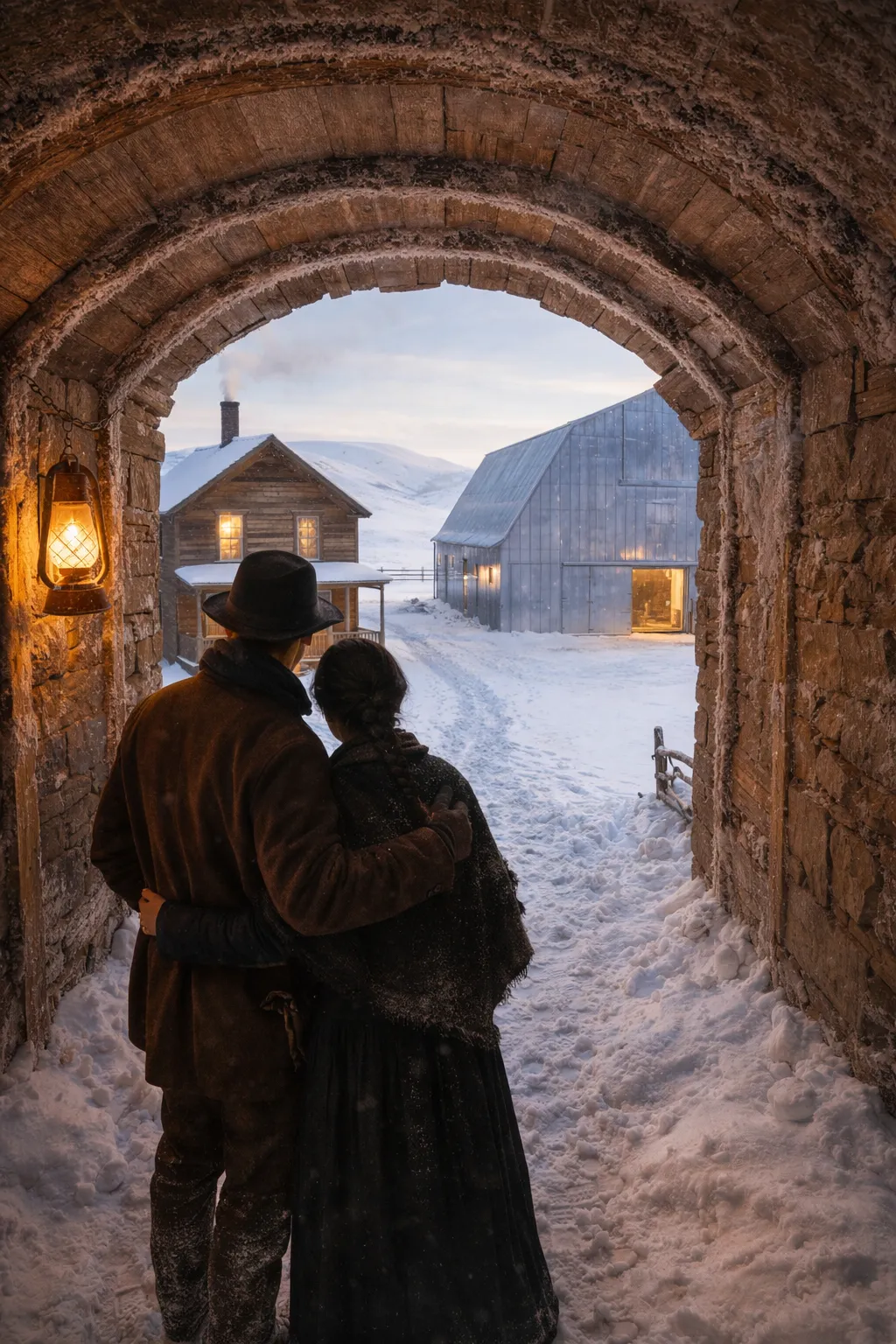
They stopped laughing the day the wind changed its voice.
It was not the first storm of that winter. Wyoming did not offer its worst all at once. It trained you first—small snows, sharp winds, cold nights that crept under doors and settled into bone. Enough to remind, not enough to break.
But this one was different.
Silas heard it before he saw it.
Not outside.
Inside the walls.
A low, rising pressure, like something pressing its weight against the cabin long before the first gust struck. He had learned that sound in another place, another war, where the air itself seemed to tense before violence arrived.
He stood by the window and watched the horizon.
Flat. White. Endless.
Then, a line.
Not dark.
Not moving fast.
But coming.
“Eleanor,” he said quietly.
She looked up from the stove.
“It’s coming early.”
She didn’t ask what it was. Out here, you learned not to waste words on what could already be felt.
The girls were upstairs, their voices soft, wrapped in the small, ordinary world of children who believed walls could hold back everything.
Silas stepped outside.
The air hit him like a warning.
Not yet cold enough to kill.
But wrong.
The kind of cold that didn’t belong to a single day. The kind that came from somewhere deeper, carried over miles without interruption.
He turned toward the barn.
Forty feet.
In summer, it was nothing.
In winter—
It was a question.
He walked it once, slowly, feeling the wind begin to gather. Testing the ground, the angle, the exposure.
Then he turned back.
By the time he reached the door, the first gust struck.
Hard.
Sudden.
It slammed into the north wall with a force that made the entire cabin shudder, a deep, hollow thud that echoed through the timber like a heartbeat gone wrong.
Inside, Eleanor froze.
Silas didn’t.
“Get the girls down,” he said.
She moved immediately.
Not frightened.
Not yet.
But fast.
Silas closed the shutters, checked the firebox, adjusted the draft. Every motion was practiced, precise. Not rushed—but not delayed.
Outside, the wind rose.
Not in steady increase.
But in surges.
Each one stronger than the last, as if something was testing the land, learning its resistance before committing to the full weight of its force.
Snow began to fall.
Not drifting.
Driving.
Sideways across the plains in sheets so dense they erased distance, erased direction, erased the idea that anything existed beyond the reach of the storm.
Silas listened.
The cabin groaned.
Timber shifted.
The roof creaked under pressure.
He moved through the space, checking each wall, each seam, each place where cold might enter and take hold.
Eleanor stood near the hearth, the girls pressed close to her sides.
“Silas,” she said quietly, “how long?”
He didn’t answer right away.
He stepped toward the door.
Opened it an inch.
The wind forced it back against his grip, a violent push that told him everything he needed to know.
He shut it again.
“Long enough,” he said.
By nightfall, the world outside had ceased to exist.
There was no horizon.
No distance.
Only motion.
Wind and snow, circling, striking, lifting, tearing.
The cabin held.
But it did not win.
It endured.
The fire burned hot, but the walls bled heat steadily, invisibly, relentlessly. The temperature inside dropped inch by inch, degree by degree, not dramatically—but inevitably.
Silas fed the fire.
Again.
Again.
Again.
Each time, the warmth rose briefly, then slipped away, stolen by the unseen hand of the wind pressing against every surface.
The girls slept in layers.
Coats over blankets.
Hats pulled low.
Their breath visible in the dim light.
Eleanor did not sleep.
She watched Silas.
Watched the way he moved, the way he listened—not just to the wind, but to the cabin itself.
“You knew,” she said at last.
It wasn’t a question.
Silas nodded.
“I knew it could come.”
“Not like this.”
“No,” he said. “Not like this.”
Another gust hit.
Harder.
The north wall shuddered.
A fine dust of frost shook loose from the seams, falling like powder into the room.
Eleanor tightened her grip on the girls.
“How do we feed the horses?” she asked.
Silas looked toward the door.
Forty feet.
In this—
It was not a distance.
It was exposure.
Time.
Risk.
He had made that walk the previous winter.
Every morning.
Every night.
Each step a negotiation with the wind, the cold, the ground that shifted and disappeared under snow.
He had come back each time with numb hands, burning lungs, a body that took hours to recover.
That was in storms smaller than this.
He turned away from the door.
“We don’t go outside,” he said.
Eleanor stared at him.
“Then how—”
He met her eyes.
“We don’t go outside.”
The tunnel was dark.
Not absolute darkness, but a muted, earthen dimness where light filtered in only faintly from either end. The air inside was still.
Not warm.
But not moving.
And that made all the difference.
Silas lit the lantern and stepped down into it.
The sound of the storm vanished.
Not entirely—but enough.
Reduced to a distant, muffled presence, like something happening in another world.
He moved forward, his boots steady on the packed earth floor.
No drifting snow.
No cutting wind.
No loss of breath.
Just distance.
Measured.
Contained.
Forty feet.
He reached the barn door and pushed it open.
Inside, the horses shifted, restless but alive. Their breath rose in steady clouds, their bodies holding heat in a way the open air could not strip away.
Silas moved among them, calm, deliberate.
Feed.
Water.
Check.
Routine.
The same work he had done every day.
But now—
Without risk.
Without urgency.
Without the constant drain of fighting the elements.
When he finished, he stood for a moment in the dim barn, listening.
The storm roared beyond the walls.
Violent.
Unyielding.
But it could not reach him here.
He turned and walked back through the tunnel.
The storm did not pass in a day.
Or two.
It settled.
It claimed the land.
By the third day, drifts had swallowed fences, buried paths, reshaped the open plains into something unrecognizable.
Men who had lived there all their lives began to make calculations they had never made before.
How much wood remained.
How far the barn really was.
How long a body could endure exposure before it began to fail.
Forty feet became something else.
A test.
A risk.
A mistake repeated too many times.
Some tried to make it.
They wrapped themselves in layers, tied ropes to doors, leaned into the wind and stepped out.
Some made it back.
Others did not.
On the fourth day, someone came.
Silas heard it faintly at first.
A sound beneath the storm.
A different rhythm.
Not wind.
Not wood.
Something human.
He moved to the door.
Opened it just enough to see.
A shape.
Low to the ground.
Struggling.
Moving in inches.
He didn’t hesitate.
Lantern in one hand, rope in the other, he stepped into the tunnel, out through the barn, and then—
Into the storm.
The wind hit him like a wall.
Not pushing.
Not pulling.
Attacking.
Snow blinded him instantly, filling his eyes, his mouth, his lungs.
He leaned forward.
Moved toward the shape.
One step.
Then another.
Time stretched.
Distance distorted.
Forty feet became everything.
He reached the man.
Grabbed him.
Turned.
And fought his way back.
Inside the barn, the man collapsed.
Half-conscious.
Frozen.
Silas dragged him through the tunnel, into the cabin.
Eleanor moved instantly, clearing space, bringing blankets, heating water.
The girls watched in silence.
Not afraid.
But changed.
Because this—
This was something they understood.
Not cold.
Not storm.
But consequence.
The man lived.
Barely.
When he woke, hours later, he looked at Silas with something that was not gratitude alone.
Recognition.
“You built it,” he said, his voice raw.
Silas nodded.
The man swallowed.
“They laughed.”
Silas said nothing.
The man closed his eyes.
“They’re not laughing now.”
By the time the storm broke, the valley was not the same.
It looked the same.
White.
Wide.
Endless.
But something beneath it had shifted.
Silas stepped out into the sunlight.
The air was still.
Quiet.
Almost gentle.
As if nothing had happened.
But he knew better.
He walked to the edge of the drift.
Looked out.
And saw the tracks.
Not many.
Some leading nowhere.
Some ending too soon.
Behind him, the cabin stood.
The barn.
And between them—
The tunnel.
Half-buried now.
Almost invisible.
But still there.
Still holding.
People came later.
Slowly.
Carefully.
They did not arrive laughing.
They did not speak loudly.
They walked the distance between cabin and barn.
Stood at the entrance to the tunnel.
Looked inside.
Measured it with their eyes.
Forty feet.
Nothing.
Everything.
They did not call it the coward’s corridor anymore.
They did not call it anything at all.
Because some things, once understood, no longer needed names.
That night, Silas sat by the fire.
The girls slept.
Eleanor rested beside them, her breathing steady, her face softer than it had been in days.
The cabin was warm.
Not perfectly.
Not easily.
But enough.
He stared into the flames.
Not thinking of the storm.
Not thinking of the men who had not made it.
Not even thinking of the tunnel.
He was thinking of something quieter.
Something deeper.
The moment, months ago, when he had stood alone in the dirt, digging something no one believed in.
When every voice around him had told him it was unnecessary.
Excessive.
Weak.
And he had continued anyway.
Not because he wanted to be right.
But because he could not afford to be wrong.
Outside, the plains stretched under the cold light of the stars.
Endless.
Unforgiving.
Beautiful.
Inside, the fire burned steady.
The walls held.
The heat stayed.
And in the space between two simple buildings—
A man’s understanding of the world had made the difference.
Not loudly.
Not proudly.
But completely.
Years later, when people spoke of that winter, they did not speak of the storm first.
They spoke of the tunnel.
Quietly.
With a kind of respect that did not need to be explained.
Because they had all learned something that year.
Something simple.
Something final.
That survival is not always strength.
Not always endurance.
Not always courage in the moment.
Sometimes—
It is understanding.
And the willingness to act on it…
Before anyone else does.