The Warmth She Hid
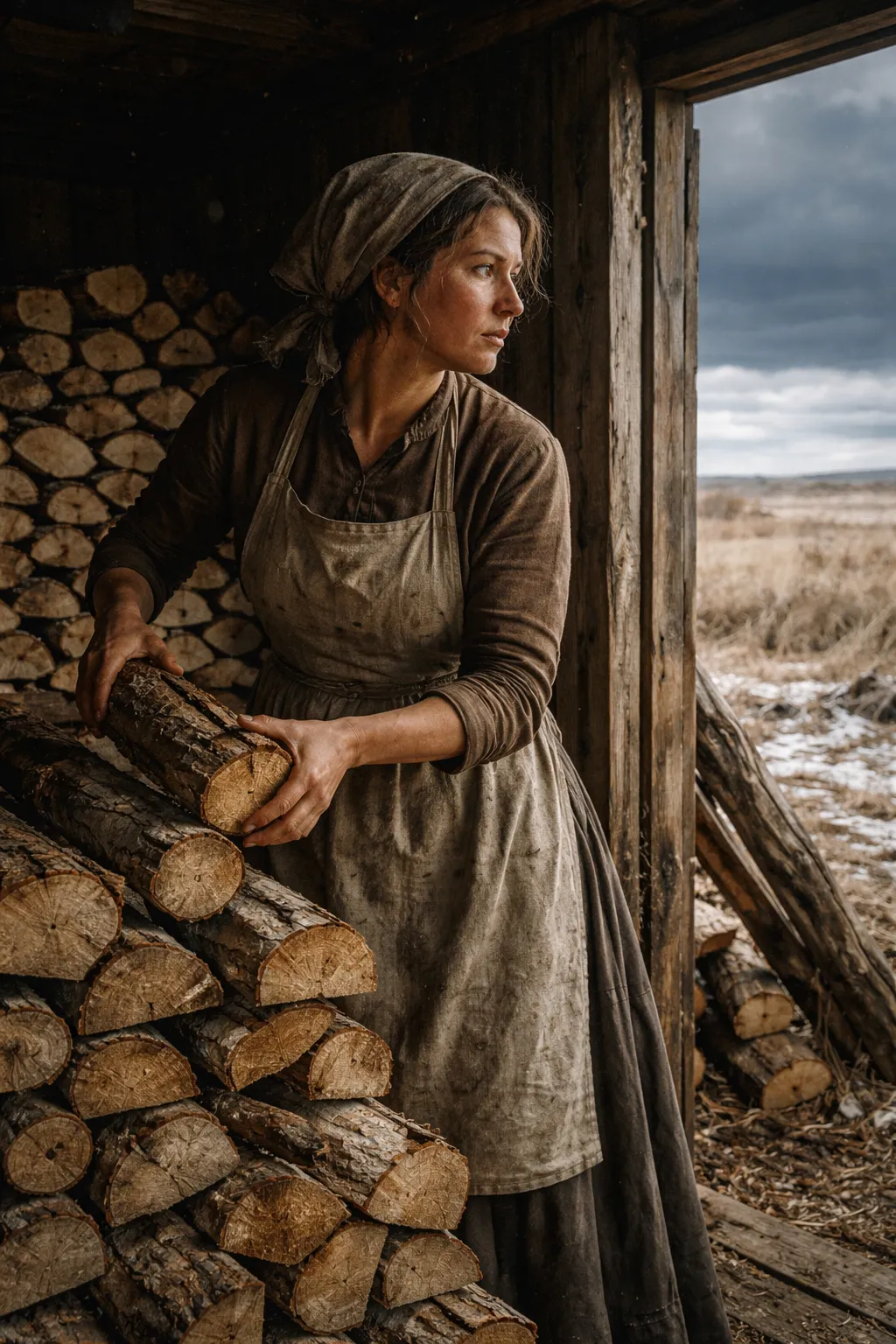
The man did not leave immediately after he saw it. He stood there, boots still wet with frozen snow, staring down into the dark, controlled space beneath Marta Voss’s woodshed as though he were looking at something that did not belong in the same world as the storm outside. His name was Anders Kline, and like most men in that valley, he had spent enough winters on the plains to believe he understood them. That belief had not survived the past six days.
“You kept it all… dry,” he said at last, his voice quieter now, stripped of the certainty it once carried.
Marta did not answer right away. She closed the trapdoor with a steady hand, brushed the dust from her palms, and moved back toward the stove. The fire burned clean, the flame narrow and strong, each log catching as though it had been cut that morning. There was no smoke hanging in the air, no coughing from the boys, no frantic stoking to keep the heat alive.
“I kept it still,” she said finally. “Dry follows that.”
Anders let out a breath he hadn’t realized he was holding. He glanced toward the door, where the wind still pressed in dull, heavy thuds against the wood, then back at the fire. Something shifted in his expression—not admiration exactly, but recognition. The kind that comes when a man realizes he has misunderstood something fundamental.
“They’re burning green wood over at Jensen’s,” he said. “Smoke so thick you can’t see across the room. His youngest—she’s not right. Breathing’s bad.”
Marta’s hands stilled for a moment.
“How much wood do they have left?”
“Plenty,” Anders said bitterly. “All of it useless.”
The room fell quiet. The boys watched without speaking, sensing the weight in the air even if they did not yet understand its full meaning.
Marta looked at the fire, then at the closed trapdoor beneath the table.
“How far?” she asked.
“Half a mile. Maybe less.”
She nodded once, as though confirming something already decided.
“Help me carry.”
Anders blinked. “In this?”
She met his eyes, steady and unyielding.
“We don’t carry outside.”
It took him a second.
Then he understood.
“You’re going under?” he asked, incredulous.
Marta shook her head. “Not the whole way. But part of it, yes.”
She moved quickly then, pulling on her coat, wrapping a scarf tight around her face. The boys stood as well.
“You stay,” she said firmly.
Peder opened his mouth to protest, but something in her tone stopped him.
“We’ll keep the fire,” he said instead.
Marta nodded, a brief softness crossing her face before it was gone.
“That’s what matters.”
The storm had reshaped the land.
What had once been open ground was now a shifting expanse of drifts and ridges, the snow packed hard in some places, hollow in others. The wind had carved it without pattern, without mercy. To step outside was to step into uncertainty, where distance could not be trusted and direction could vanish in a matter of seconds.
But Marta did not walk blindly.
She had studied this land the same way she had studied the space beneath her woodshed—quietly, over time, paying attention to what others dismissed. She knew where the ground dipped, where the hill broke the wind, where the snow would gather and where it would be stripped away.
“Stay close,” she said to Anders.
He followed, struggling at first against the instinct to fight the wind directly. Marta did not fight it. She moved with it, angling her body, choosing her steps with care, never wasting energy on resistance that would only drain her.
They reached Jensen’s cabin in less time than Anders would have believed possible.
Inside, the air was thick.
Not with warmth.
With smoke.
It hung low, gray and choking, stinging the eyes, clinging to the throat. A child coughed somewhere in the dimness, a thin, strained sound that cut through the room more sharply than the wind outside.
Jensen looked up as they entered, his face drawn and hollow.
“You shouldn’t be out,” he said hoarsely.
Marta moved past him without answering, going straight to the stove. She opened it, examined the fire, the wood stacked nearby.
Wet.
Half-frozen.
Useless.
She turned to Anders.
“Bring it in.”
He hesitated. “We’ll have to go back—”
“No,” she said. “You’ll bring it from here.”
He stared at her.
“How?”
Marta looked toward the floor.
“Where’s your root cellar?”
Jensen blinked, confused.
“Under the back corner. Why?”
“Show me.”
It was not the same as her woodshed.
Not built for this purpose.
But it was space.
Enclosed.
Still.
And that was enough.
They worked quickly, moving what dry wood Marta had brought into the cellar, sealing off drafts as best they could with cloth and packed earth. It was not perfect. It would not hold for long.
But it would change something.
It would buy time.
When they brought the first of that wood up and placed it in the stove, the difference was immediate.
The flame caught.
Clean.
Strong.
Jensen stared at it as though he were seeing fire for the first time.
“How—” he began.
Marta shook her head.
“Later,” she said. “Right now, you keep it going.”
The child’s coughing began to ease as the smoke thinned, replaced by real heat. Not enough to make the room comfortable. But enough to make it livable.
Anders watched it all in silence.
When they finally stepped back outside, the storm had not lessened. But something inside him had shifted.
“You saw it before it happened,” he said as they moved back toward her cabin.
Marta did not slow.
“No,” she said. “I just didn’t wait for it to prove me wrong.”
In the days that followed, word spread—not in loud declarations, but in quiet, urgent exchanges between those who had begun to understand that winter was not something to endure blindly.
People came.
Carefully.
One by one.
They did not come to mock.
They came to learn.
Marta did not welcome them warmly.
But she did not turn them away either.
She showed them what mattered.
Not the exact measurements.
Not the precise arrangement.
But the principle.
“Wind is what takes your heat,” she said. “Stop the wind, and you keep what you have.”
Some listened.
Some did not.
But enough did.
Enough to change what that winter would become.
By the time the storm finally broke, weeks later, the valley was not the same.
There were losses.
There always were.
But fewer than there might have been.
And among those who remained, there was a new understanding—not of comfort, not of ease, but of something deeper.
Preparation.
Not as fear.
But as respect.
For the land.
For the cold.
For the quiet lessons that reveal themselves only to those willing to see.
That spring, when the snow began to melt and the ground softened once more, people built differently.
Not all of them.
Not perfectly.
But differently enough.
And beneath one small woodshed, in a space no one had believed in, there remained the memory of a winter that had almost taken everything—
And of a woman who had refused to let it.
Not by strength alone.
Not by luck.
But by understanding.
And by acting on it…
Before anyone else did.