Why Trump Left the G7 Early — And What the Fractures at This Summit Really Revealed
When leaders leave a summit early, it is rarely about scheduling.
It is about distance—political, ideological, and increasingly, strategic.
Donald Trump’s decision to walk out of the recent G7 meeting ahead of schedule was not impulsive. By the time he departed, the divisions in the room had already hardened. The early exit simply made visible what had been unfolding quietly throughout the summit’s first sessions: a growing incompatibility between Trump’s worldview and that of America’s traditional allies.
The Russia Question That Reopened Old Wounds
The first rupture came when Trump openly criticized the decision to expel Russia from the former G8.
He argued that had Russia remained within the group, the war in Ukraine might never have occurred—a statement that landed heavily across the table. For European leaders, many of whom view Russia’s expulsion as a moral and strategic necessity, the comment felt like a reopening of a chapter they consider settled.
The reaction was immediate and restrained—but unmistakable.
Disapproval did not come through raised voices, but through tightened expressions and clipped responses. For Trump, who often uses provocation to test consensus, the moment confirmed what he already believed: that the G7 no longer operates from shared assumptions about global order.
A Refusal That Ended the Illusion of Unity
The second—and more decisive—break occurred during discussions on the Middle East.
European leaders had carefully drafted a joint statement calling for de-escalation, hoping to present a united front amid rising regional tensions. Trump refused to sign it.
His refusal was not dramatic. It was procedural. But it was final.
Without the United States, the statement lost its symbolic power. What was meant to signal unity instead highlighted fragmentation. For many observers, this was the moment the summit quietly failed—not because of conflict, but because consensus proved impossible.
Trump’s stance underscored a core difference: where others sought collective signaling, he questioned the value of multilateral messaging altogether.
Rare Earths, Tariffs, and a Missed Convergence
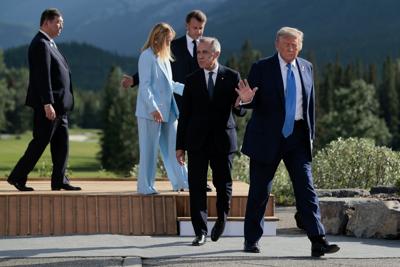
As tensions mounted, the European Union attempted a pivot.
Ursula von der Leyen brought rare earth material samples to the table, a tangible gesture meant to underscore Europe’s strategic importance in global supply chains. The hope was that cooperation in this critical sector might persuade Washington to reconsider tariffs and reframe economic relations.
The effort gained little traction.
Trump showed limited interest, reinforcing a long-standing skepticism toward trade concessions not tied directly to immediate national advantage. The moment illustrated another divide: Europe’s preference for long-term interdependence versus Trump’s emphasis on leverage and bilateral advantage.
The samples remained on the table. The gap remained unresolved.
The Walkout That Said More Than Words
By the time Trump left the summit early, the outcome was already clear.
This was no longer a gathering of aligned partners navigating disagreements. It was a collection of nations prioritizing divergent interests, bound more by habit than harmony.
Trump’s departure did not cause the division.
It revealed it.
For decades, the G7 functioned on the assumption that shared values would outweigh national friction. This summit suggested that assumption may no longer hold. As global pressures intensify—from war to trade to resource competition—unity is becoming harder to perform, let alone sustain.
What This Summit Signals Going Forward
Trump’s early exit should not be read as a collapse of diplomacy, but as a signal of transition.
The G7 is not ending.
But it is changing.
Where once consensus was the goal, coexistence of disagreement may become the norm. And for leaders like Trump, who measure effectiveness through sovereignty rather than solidarity, that shift is not a flaw—it is a feature.
The summit ended without dramatic confrontation.
But it ended with something more consequential: clarity.
The G7 still meets.
But it no longer moves as one.
And this summit made that unmistakably clear.