The Super Bowl That Wasn’t: How One Absence Sparked a Storm of Speculation
In America, the Super Bowl is more than a game—it’s a national ritual. A moment where sports, culture, and identity collide under the brightest lights.
So when Donald Trump was said to be absent, it didn’t just pass quietly.
It echoed.
Within hours, social media began to fill the silence with something else—stories. Claims that the National Football League had reacted swiftly. That security had been tightened beyond precedent. That exclusive spaces had been reassigned. That even the halftime show had been quietly reshaped in response.
It was a narrative that spread quickly—because it felt satisfying.
But here’s the truth: there is no verified evidence that any of it happened.
No official announcement.
No credible reporting.
No confirmation from the league, the venue, or the artists involved.
And yet, the story traveled far.
Why?
Because it tapped into something deeper than facts.
For many Americans and Britons—especially those who have watched public life grow more polarized over decades—figures like Trump are no longer just individuals. They are symbols. To some, of defiance. To others, of disruption.
So when a story suggests that a powerful institution like the NFL might “push back,” it resonates. Not because it’s proven—but because it aligns with how people feel the world works.
The Reality Behind the Spectacle
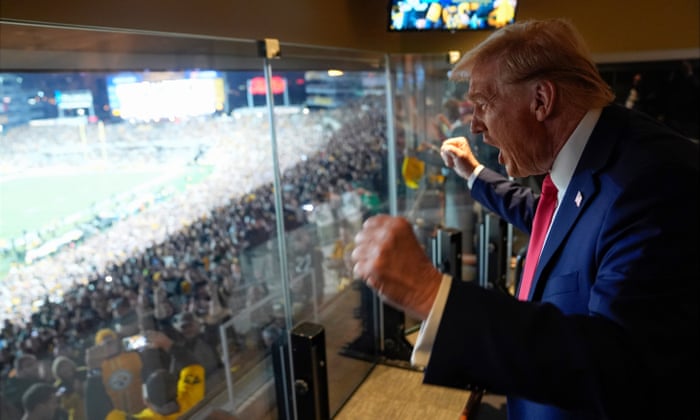
In reality, events like the Super Bowl are built on precision.
Security planning involves federal, state, and local agencies, coordinated months in advance. VIP access, private suites, and logistics are locked in long before kickoff. The halftime show—whether featuring global artists like Bad Bunny or others—is the result of extensive contracts, rehearsals, and broadcast agreements.
There is no room for last-minute, emotionally driven decisions.
Not at that scale.
The Power of a Good Story
And yet, the idea persists.
Because in a world saturated with information, people are no longer just consuming news—they are searching for meaning. For narrative. For a sense that events, even small ones, are part of a larger story.
The claim that the NFL acted decisively in response to Trump’s absence offers that sense of order. Of cause and effect. Of action and reaction.
It feels complete.
Even if it isn’t true.
A Mirror, Not a Moment
In the end, this wasn’t really about a football game.
It was about perception.
About how quickly a story can form when public figures, powerful institutions, and cultural moments intersect. About how easily speculation can fill the gaps left by silence.
And perhaps most importantly—about how, in today’s world, what feels real can sometimes travel further than what is real.
Because sometimes, the biggest story…
isn’t what happened.
It’s what people believed happened.