Jesse Jackson’s farewell became more than a memorial — and it reignited America’s long political rivalry
When the nation gathered in Chicago to honor civil rights icon Jesse Jackson, the ceremony was expected to be a moment of unity and remembrance. For more than half a century, Jackson had stood at the center of America’s fight for civil rights, voting access, and economic justice.
The memorial service drew thousands, including some of the most recognizable figures in American political life.
Former presidents Bill Clinton, Barack Obama, and Joe Biden attended the ceremony, delivering tributes to the man whose activism helped reshape modern American politics.
But one notable absence quickly caught the attention of political observers: Donald Trump.
Trump did not attend the funeral, and neither did members of his family.
That absence immediately sparked questions across political media and social networks. Why would a former president skip the farewell of such an influential figure?
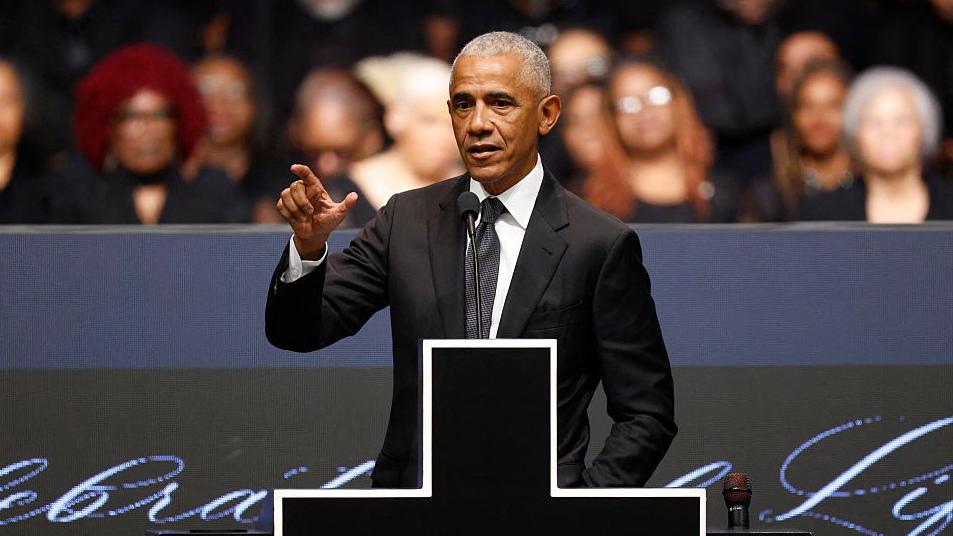
As the ceremony unfolded, many viewers began pointing to a moment during Obama’s speech that appeared to explain the tension behind the scenes.
A life that shaped American history

Before the political discussion began, the day was first and foremost about Jackson’s extraordinary legacy.
A close ally of Martin Luther King Jr., Jackson emerged from the civil rights movement of the 1960s to become one of the most influential activists of the next generation.
Through the organization he founded, Rainbow PUSH Coalition, Jackson pushed for economic equality, voter registration, and greater representation for marginalized communities.
His presidential campaigns in 1984 and 1988 broke barriers that many believed impossible at the time.
For younger generations, those campaigns helped pave the way for the historic election of Barack Obama in 2008.
That history made Obama’s appearance at the memorial particularly meaningful.
In many ways, he represented the future Jackson had spent decades trying to build.
Obama’s speech that stirred discussion
When Obama took the podium, his tribute began with deep respect.
He spoke about Jackson’s courage during the civil rights era and the risks activists took when confronting segregation and injustice.
Obama described Jackson as someone who believed America could live up to its highest ideals—even when progress seemed painfully slow.
But as the speech continued, Obama also reflected on the present moment in American politics.
Without mentioning Trump directly, he warned about the dangers of division, political cruelty, and rhetoric that pits Americans against one another.
Those remarks drew applause inside the church and quickly spread across social media.
Political analysts immediately noted that the message seemed aimed at broader political trends many associate with Trump-era politics.
The long rivalry between Obama and Trump
The tension between Obama and Trump is not new.
Their political rivalry stretches back more than a decade and has often been deeply personal.
Trump was one of the most prominent voices questioning Obama’s birthplace during the “birther” controversy that dominated headlines in the early 2010s.
Obama later mocked Trump during the 2011 White House Correspondents’ Dinner, a moment many observers believe intensified their rivalry.
Since then, both men have frequently criticized each other’s leadership and policies.
Because of that history, even indirect comments during a major public event can be interpreted through the lens of their ongoing political conflict.
Why Trump’s absence drew attention
Trump’s decision not to attend the memorial added another layer to the story.
Presidential funerals and memorials often serve as rare moments when political rivals share the same space.
In the past, Americans have seen presidents who disagreed fiercely in politics stand side by side to honor national figures.
Those images can symbolize continuity in American democracy.
When one major political figure is absent, people naturally begin asking why.
Some analysts suggested scheduling or security logistics might have influenced the decision.
Others speculated that the highly political atmosphere surrounding the event may have made attendance uncomfortable.
Regardless of the reason, the absence itself became part of the narrative.
The debate over political tributes

The Jackson memorial also raised a familiar question in American public life: should funerals remain entirely free from political commentary?
Supporters of Obama’s remarks argued that Jackson’s entire life was political. He fought for voting rights, racial justice, and economic reform.
Speaking about the political climate, they said, was consistent with the values Jackson represented.
Critics, however, argued that memorial services should focus exclusively on honoring the individual rather than criticizing contemporary political figures.
This debate is not new.
Throughout history, the funerals of major political figures—from civil rights leaders to presidents—have often included reflections on the state of the nation.
The deeper meaning of the day

Despite the political discussion that followed, the heart of the ceremony remained Jackson’s life and legacy.
Choirs sang gospel hymns.
Family members shared personal memories.
Civil rights leaders spoke about the battles Jackson fought long before many Americans were born.
For those who had marched beside him in the 1960s, the day was a reminder of how far the country had come—and how far it still had to go.
Obama himself acknowledged that Jackson’s work helped make his own presidency possible.
Without the movements Jackson helped build, the path to the White House for a Black president might have remained closed for generations.
A moment that reflects modern America
The reaction to Jackson’s funeral revealed something larger about today’s political climate.
Even a memorial service for a civil rights icon quickly became intertwined with modern political rivalries.
Supporters and critics of Trump and Obama interpreted the same events in completely different ways.
Some saw Obama’s remarks as a necessary defense of democratic values.
Others viewed them as an inappropriate attack during a moment meant for unity.
The divide illustrated just how deeply political identities now shape how Americans interpret public events.
What history will remember
In the years ahead, historians will likely focus less on the political drama surrounding the memorial and more on the life being honored.
Jesse Jackson spent decades fighting for those who felt invisible in American politics.
He registered millions of voters.
He negotiated for the release of hostages overseas.
He built coalitions that brought together communities across racial and economic lines.
Those achievements remain the true legacy of the day.
Political arguments may dominate headlines for a time.
But the larger story—the life of a man who believed America could become more just—will endure far longer.