Why Rumors About Trump’s ‘Disappearance’ Took Off — And What the Photos Actually Show
In the age of high-definition cameras and low trust, silence breeds stories.
When Donald Trump went nearly four days without a public appearance, the absence itself became the headline. For a man who has spent decades filling every available space—physical, political, and psychological—quiet felt unnatural. Online speculation rushed in to fill the gap.
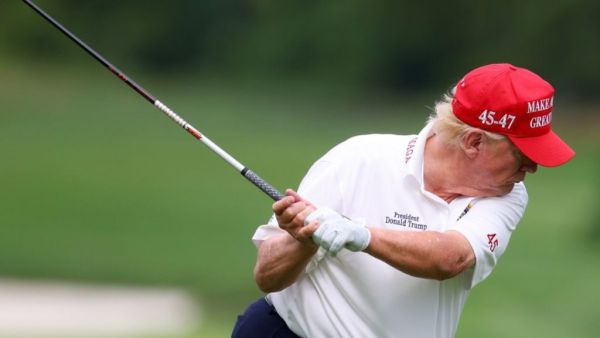
By the time reporters spotted Trump heading to a Virginia golf course over the weekend, social media had already decided something was “off.”
What followed wasn’t evidence of conspiracy—but a textbook example of how modern rumor cycles work.
The First Trigger: Absence Creates Anxiety
Trump had no scheduled rallies, no televised appearances, no surprise press moments. For most politicians, that wouldn’t register. For Trump, whose presence has long been performative and constant, it felt jarring.
Photos circulated of past appearances showing swollen ankles and bruising on his hands—images that had already been explained by age, medication, and routine medical procedures. But online, context evaporates quickly. Old images were recirculated without timelines, giving the impression of sudden deterioration.
Silence plus recycled visuals created a vacuum—and speculation poured in.
The Hat Color That Launched a Theory

One of the most shared claims was deceptively simple: Trump appeared to wear a white cap when leaving the golf course and a red one when returning.
To conspiracy-minded observers, this became “proof” of a stand-in.
In reality, Trump has frequently changed hats during outings—often gifting them, switching for photos, or responding to weather and glare. Golf trips, especially private ones, are not staged press events. Lighting, camera angles, and compression artifacts can also dramatically alter color perception in photos and video.
What looked like inconsistency was far more likely mundanity.
The Face Color Myth
Another viral claim focused on Trump’s complexion.
For years, commentators have joked about his orange-toned makeup. In the golf footage, his face appeared paler and tired. Some immediately leapt to the conclusion that this meant the man wasn’t Trump at all.
A simpler explanation exists: early-morning lighting, lack of stage makeup, physical exertion, and high-definition lenses are brutally honest. Politicians look different offstage. Aging looks different when not filtered through television studios.
Exhaustion is not impersonation.
Why Kai Trump’s Behavior Was Misread

Perhaps the most uncomfortable part of the speculation involved Trump’s granddaughter, Kai.
Observers claimed she appeared distant as she entered the car, reading her body language as evidence that something was “wrong.”
This is where rumor culture crosses into something darker.
Teenagers are not political props. Awkwardness, haste, or emotional neutrality—especially under cameras—are not signals. Projecting adult conspiracies onto a child’s behavior says far more about the observer than the subject.
What This Episode Really Reveals
There is no credible evidence Trump was replaced, doubled, or deceased.
What is evident is something more telling: a growing mistrust of appearances themselves.
In a polarized environment, people no longer ask, “Is this true?”
They ask, “Does this feel believable given what I already think?”
Trump’s public persona—larger than life, theatrical, defiant—has conditioned audiences to expect constant visibility. When that visibility pauses, the pause becomes suspicious.
Not because of facts.
But because of habit.
The Real Story Isn’t a Double — It’s Disbelief
This moment wasn’t about hats, makeup, or golf carts.
It was about how quickly uncertainty mutates into certainty online—and how even familiar figures become strangers once trust erodes.
Trump didn’t disappear.
He stepped out of frame.
And in 2026, that alone is enough to make the internet invent a replacement.