The Viral White House Moment: Did Armenia and Azerbaijan Really “Embarrass” Trump?
A brief whisper.
A handshake.
A camera angle frozen at just the right second.
And suddenly, the internet had a theory.
When Armenian Prime Minister Nikol Pashinyan and Azerbaijani President Ilham Aliyev appeared alongside Donald Trump at the White House, social media lit up with speculation. Some online commentators claimed the two leaders had orchestrated a subtle diplomatic slight — even a calculated attempt to make Trump look sidelined during a historic moment.
But does the footage support that conclusion?
Or is this another case of viral interpretation overtaking reality?
A High-Stakes Setting
Any diplomatic meeting involving Armenia and Azerbaijan carries enormous historical weight. The two nations have endured decades of tension and conflict, particularly over the Nagorno-Karabakh region. When leaders from both countries appear together in a public signing ceremony, every gesture is magnified.
In such environments, optics matter.
But so does context.
Public ceremonies are carefully choreographed — yet they are also human moments. Leaders confer, clarify translation, confirm protocol, or exchange brief remarks. A whisper captured mid-frame can appear conspiratorial when stripped of sound and surrounding dialogue.
The Power of a Split Second
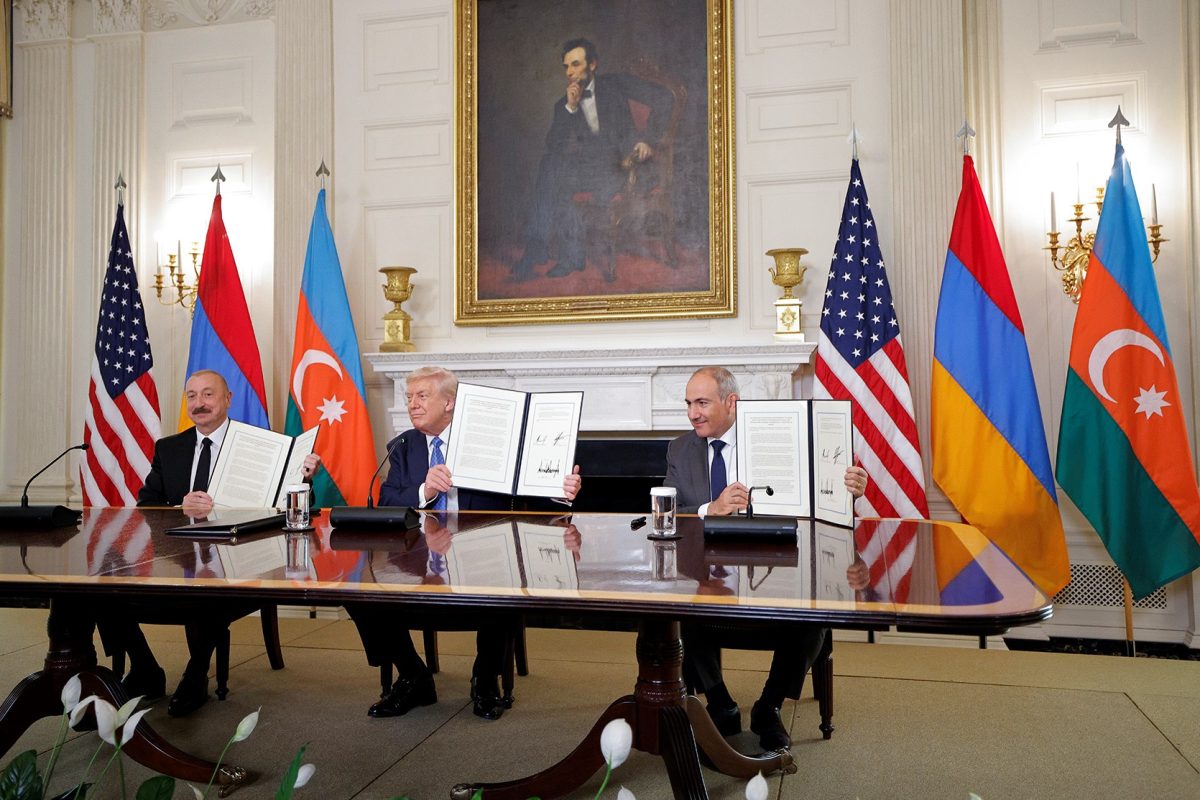
Video clips circulating online focus on a brief moment when Pashinyan and Aliyev exchanged words and shook hands while Trump stood nearby. Some viewers interpreted Trump’s expression as displeased or excluded.
But body language is notoriously subjective.
A pause can be reflection.
A frown can be concentration.
A side conversation can be logistical coordination.
Diplomatic ceremonies are often multilingual. Leaders frequently confirm specific phrasing or procedural steps in real time. What looks like a “private whisper” can be routine clarification.
The Reality of Diplomatic Optics
In high-level negotiations, no leader benefits from publicly embarrassing the host of a diplomatic event — especially at the White House. International agreements rely on mutual recognition and symbolic unity.
If Armenia and Azerbaijan were indeed finalizing or symbolically affirming a breakthrough, the global message would be cooperation — not humiliation.
Diplomatic optics are strategic.
Alienating a mediator rarely serves long-term interests.
Why the Narrative Took Off
So why did the “plot” theory spread?
Because viral media thrives on contrast.
Two leaders appearing calm and whispering.
A third leader momentarily unspeaking.
A freeze-frame facial expression.
Add dramatic captions and music, and a routine diplomatic gesture becomes a storyline.
In today’s digital ecosystem, micro-moments are magnified. Complex geopolitical realities are compressed into emotionally charged clips.
But interpretation is not evidence.
Reading Between the Frames
It’s also worth remembering that diplomatic negotiations are not single-day spectacles. They involve months — sometimes years — of groundwork by teams of advisors, diplomats, and negotiators.
A signing ceremony represents culmination, not improvisation.
Whatever expressions appeared in that moment, they do not negate the broader diplomatic context or redefine the outcome of long-running regional tensions.
The Bigger Lesson
This episode highlights a broader truth about modern political media:
Optics can overpower nuance.
A three-second whisper can overshadow decades of conflict resolution efforts. A single facial expression can dominate headlines more than policy substance.
But diplomacy rarely unfolds in cinematic clarity. It moves in quiet exchanges, technical clarifications, and incremental steps.
Before concluding that a global embarrassment occurred, it’s worth asking:
Are we watching history —
or just watching a frame?
In a world where viral narratives form in minutes, critical thinking remains the most important tool of all.